

Echoes of the Revolution is a new blog series highlighting innovative and ambitious public history projects undertaken by students and faculty at New Jersey’s colleges and universities. Inspired by the ideals, contradictions, and unfinished promises of the American Revolution, the series will explore how public history initiatives engage with questions of liberty, equality, citizenship, and historical memory. While not all projects will focus directly on the Revolutionary era, each will illuminate ways in which its legacies continue to shape our understanding of the past and present. From recovering underrepresented histories to developing exhibitions, interpretive signage, and digital resources, Echoes of the Revolution will showcase how academic institutions are collaborating with communities to uncover new stories, challenge established narratives, and make New Jersey’s history accessible to broader audiences.
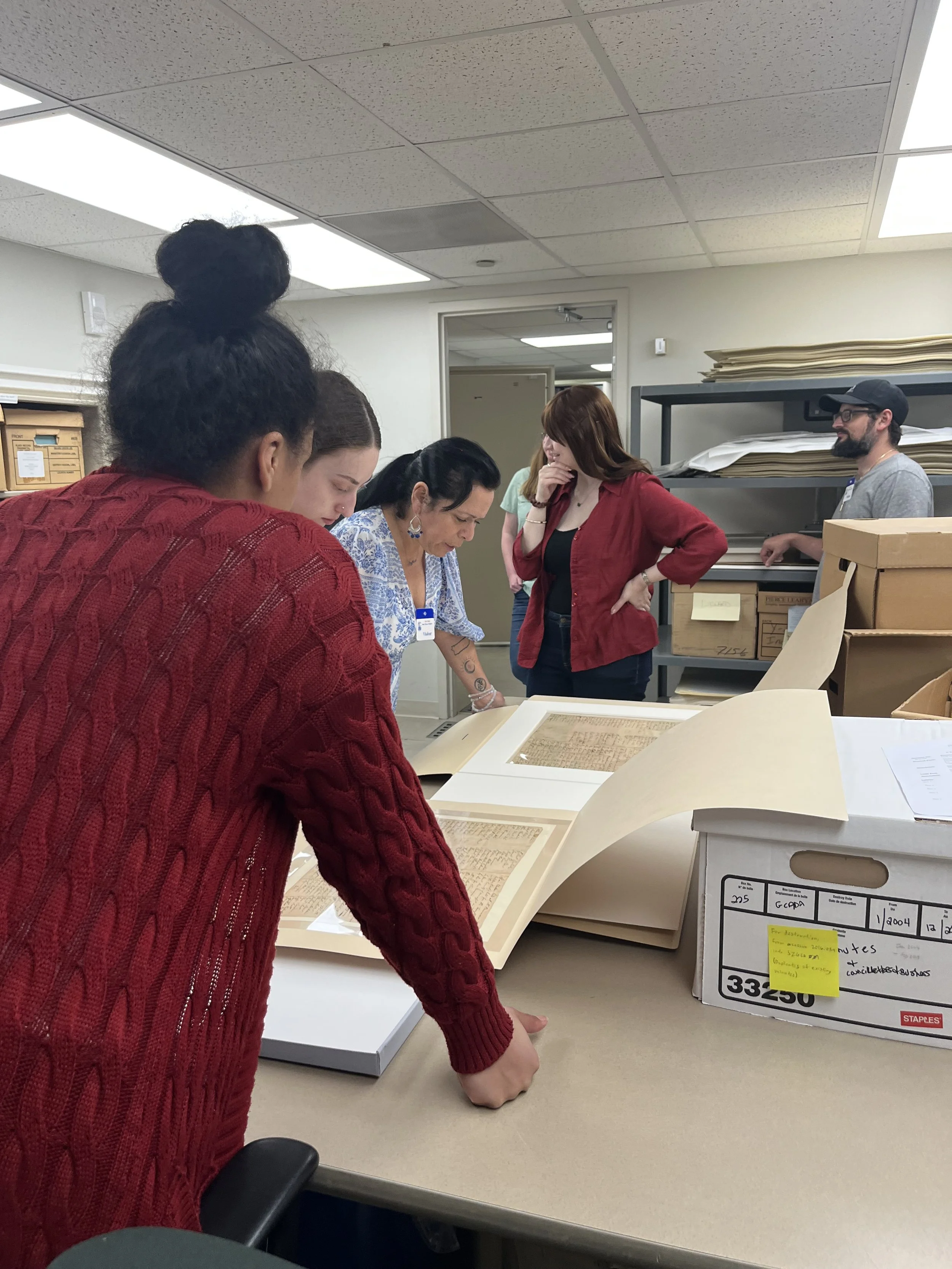
Students in Dr. Denise Rompilla's History of Women's Honors course examining documents at the NJ State Archives.
As we mark the 250th anniversary of the American Revolution, there is understandable pressure to produce exhibitions, programs, and public interpretations that coincide with commemorative milestones. Yet meaningful historical scholarship cannot always be made to conform to an anniversary calendar.
Too often, women's experiences during the American Revolution are presented through familiar interpretive tropes: women in period costume demonstrating household tasks, portraying the wives of prominent men, or embodying conventional ideals of patriotism and sacrifice. While living history interpretation can provide valuable opportunities for public engagement when grounded in inclusive, historical scholarship - a notable example of which is the New Jersey Historical Commission’s own Tavern Talks - many historical reenactments of women in the American Revolution continue to reduce women's experiences to a narrow set of domestic roles. (1) Moreover, the familiar domestic tableaux staged at many historic sites becomes far more difficult to sustain when we ask whose labor maintained the household, who exercised authority, and who within that household was denied their freedom. (2)
The central irony of such performances is that the American Revolution profoundly disrupted domestic lives. Women navigated military occupation, economic uncertainty, political divisions, and changing social relationships, often under harrowing circumstances. For enslaved women, these experiences were further shaped by the conditions of their enslavement, as well as the uncertainties and possibilities created by war. Moreover, with a few notable exceptions, women’s political allegiances during this period defy easy categorization. Recovering these histories requires us to move beyond familiar images and examine the documentary evidence that reveals the complexity and diversity of women's lives.
The Revolutionary She
Our research into women's experiences in Revolutionary New Jersey demonstrates why this process matters. Now entering its third year, The Revolutionary She began with a curriculum grant from the New Jersey Historical Commission and has evolved into an ongoing collaborative research project engaging several community partners. At its center are students enrolled in the Middlesex College Honors Program’s History of Women Honors course, where rigorous archival research and original historical scholarship provide the course’s intellectual framework. In collaboration with professional archivists, particularly NJ State Archivist Vivian Thiele and Catherine Gulick-Tuers, students work directly with primary sources to recover and reinterpret the experiences of women whose lives have often been obscured by traditional Revolutionary War narratives, starting with the women in their own backyard – Revolutionary Middlesex County. Rather than simply categorizing women as Patriots or Loyalists, their research reveals a far more complicated world of personal relationships, economic circumstances, political uncertainty, and decisions made during war and Middlesex County’s military occupation by the British from December 1776 through June 1777.
Among the first documents we examined as a class were the Inventories of Damages by the British and Americans in Middlesex County 1776-1782. (3) The inventories were compiled by county appraisers appointed under a December 1781 act of the New Jersey Legislature to assess property losses suffered during the Revolutionary War. Beginning in 1782, residents submitted itemized accounts of their losses, including estimated monetary values, which were supported by sworn statements and, in some cases, eyewitness testimony. The appraisers collected these claims and submitted them to the state legislature to help determine possible compensation for residents.
Previously accessible primarily through microfilm or by appointment, these records became the focus of an important collaboration with the New Jersey State Archives. Through the generosity and support of State Archives staff, the entire volume of Middlesex County Revolutionary War Damage Claims was digitized and made available to History of Women Honors students for research. Just as importantly, this collaboration has made a significant collection of primary source documents more widely accessible to the public, extending the impact of The Revolutionary She well beyond the classroom.
What we did not expect to encounter, on the very first page, was the harrowing account of Elisabeth Graham of Bound Brook. (4) In the longest entry among the claims, Graham described how she and her now-deceased husband Ennis Graham had been confronted by the Queen’s Rangers at their isolated home. With bayonets pointed at their backs, they were marched into their barn and ordered to dig up jewelry and silverware that had been buried beneath the dirt floor. Graham’s testimony offers a chilling glimpse into the violence, intimidation, and vulnerability experienced by civilians, including women, during the Revolution. These are stories that are largely absent from traditional narratives.
Yet the same account introduces a troubling complication. Among the missing property, listed between “a silver watch with chain and seal of agate” and one “silver pint mug” is “A Negro fellow name Oliver.” (5) Suddenly, our understanding of Elisabeth Graham becomes far more complex. Oliver is listed as “property” according to the legal framework of the time, and a source of wealth for a widow’s estate. Should we, then, still sympathize with Elisabeth Graham as a victim of wartime violence? Or should we cast our sympathies aside upon learning that she was a member of a household that participated in enslavement, and by default upon her husband’s death, the head of that household making the claim? Even her political allegiances remain uncertain. Was she a Patriot, a Loyalist, or someone primarily concerned with protecting her family and property? The fragmented evidence of women’s lives does not offer easy answers. Instead, it invites us to ask more meaningful questions about the intersecting experiences of violence, vulnerability, wealth, and slavery in Revolutionary Middlesex County.
Our current research into the life of Sarah Ross offers another example of the complexities that emerge when we look beyond familiar narratives. What began as a feel-good story of “the Widow Ross,” the woman who hosted George Washington in her home in Piscataway in July 1778, has become something far less straightforward. It was previously known, through George Washington’s orders and contemporary soldiers’ accounts, that Ross Hall was selected by Washington as his headquarters after the Battle of Monmouth in late June. (6) It was in the library at Ross Hall that Washington wrote the orders for a patriotic celebration to be held on July 4th, with Washington, Alexander Hanilton, and the Marquis de Lafayette attending a patriot’s ball on its very grounds the next day. The “feu de joie”, the firing of cannons and musketry along the banks of the Raritan River ordered by Washington, is thought to be the predecessor of the fireworks celebration of July 4th. (7)
But through painstaking archival research facilitated by our partners at the NJ State Archives, and increasingly, at archives in the Caribbean and in Europe, we are beginning to uncover a woman whose life was connected to a world of wealth built upon the brutal sugar economy of Jamaica and the mercantile exchange of Raritan Landing. (8) The same woman who hosted a ball on the Fourth of July toasting to America’s liberty ran a household on enslaved and indentured labor, and at various times throughout the war, placed ads in colonial newspapers for their quick sale. (9) And our recent discovery of Sarah Ross’s marriage to a British surgeon mere weeks after Washington’s departure in July 1778, raises questions about political allegiances, the relationship between luxury and exploitation, and the determination to protect property and wealth amid the upheaval of war. (10) Rather than fitting neatly into the familiar categories of Patriot or Loyalist, Sarah Ross emerges as a figure whose actions force us to reassess the social realities of the wealthy elite in Revolutionary Middlesex County. The fact that Ross Hall, and other stately homes like it above the river, remained relatively intact during the British occupation challenges us to reconsider how wealth, privilege, and geography shaped not only the experience of war, but also the ability to escape war’s worst consequences. (11)
One thing is strikingly clear: the women emerging from our research bear little resemblance to the familiar portrayals of eighteenth-century womanhood encountered in many living history settings. The women at the heart of our historical inquiry could be politically astute, strategically calculating, fiercely protective of their own interests, and, at times, willing to exploit the circumstances and inequalities of the world around them. They are not always likeable, nor do they have to be. One of the most important lessons for students of women’s history is that the field is not merely a search and rescue mission to unearth and celebrate a new pantheon of admirable women. Research into women’s lives often leads us into uncomfortable territory, but we must follow where the evidence leads. The experiences of Revolutionary women in Middlesex County demand that we consider these women in all their complexity. The inclusion of “unlikeable” characters allows us to tell a fuller, richer story.
This is where public history has an essential role to play. While commemorative anniversaries provide valuable opportunities to engage the public, the pressure to produce exhibitions, programs, and interpretations to coincide with predetermined milestones should never take precedence over rigorous, inclusive scholarship. Historic sites, exhibitions, and educational programs have an opportunity – and I would argue, an ethical responsibility – to slow down, do the work, and present these more challenging narratives to the public. Rather than rely on the familiar binary of Patriot versus Loyalist, or retreat to reassuring performances of domestic womanhood, we can invite audiences to consider how political allegiances intersected with women’s personal relationships, economic interests, social inequalities, and the daily realities of war. In doing so, we encourage a more nuanced understanding of women in Revolutionary New Jersey, one that recognizes that women's experiences in this tumultuous period were just as varied, contradictory, and consequential as those of men.
Footnotes:
1 As feminist historian Laurel Thatcher Ulrich demonstrates in The Age of Homespun: Objects and Stories in the Creation of an American Myth, the nineteenth-century romanticization of women at the spinning wheel emerged alongside the industrialization of textile production, even as women's participation in the expanding factory workforce challenged traditional notions of domestic femininity. See Laurel Thatcher Ulrich, The Age of Homespun: Objects and Stories in the Creation of an American Myth (New York: Alfred A. Knopf, 2001), particularly pages 15-40.
2 The living history performances of Revolutionary era figures by white women, however well-intention, can inadvertently erase the lives and labor of enslaved Black women and indentured women at these sites, and by extension, questions of wealth, class, and power between women during this period.
3 Inventories of Damages by the British and Americans in New Jersey, 1776–1782, Middlesex County, Series SLE00003, New Jersey State Archives, Department of State, Trenton, NJ.
4 Inventory of Damages for Elisabeth Graham, Middlesex County, December 1776, Inventories of Damages by the British and Americans in New Jersey, 1776–1782, Series SLE00003, pages 1-4; New Jersey State Archives, Department of State, Trenton, NJ, pages 1-4, testimony on pages 2-4.
5 Inventory of Damages for Elisabeth Graham, page 1.
6 See George Washington, “General Orders, 3 July 1778,” Founders Online, National Archives, The Papers of George Washington, Revolutionary War Series and Washington, “General Orders 4 July 1778,” Founders Online, National Archives, The Papers of George Washington, Revolutionary War Series, https://founders.archives.gov/?q=General%20Orders%203%20July%201778&s=1111211111
7 Reenactments of the “feu de joie” are staged by the Division of History and Historic Preservation of Middlesex County each year at East Jersey Old Town Village in Piscataway, New Jersey, as part of their Fourth of July celebrations.
8 Alexader Ross, Sarah [Farmer] Ross’s first husband, died only seven months into their marriage on November 30, 1775. His will, held at the New Jersey State Archives, details land holdings in Jamaica, where Ross, a Scottish surgeon, appears to have made the wealth that allowed him to purchase the former Edward Antill estate in Piscataway, christened Ross Hall, in 1768. See Alexander Ross, Last Will and Testament, July 2, 1775, proved February 14, 1776, Wills and Inventories, ca. 1670–1900, Secretary of State’s Office, Series SSTSE033, New Jersey State Archives, Department of State, Trenton, NJ.
9 See, for example, the advertisement placed by “Mrs. Ross” of “Brunswick” for the sale of a 14-year-old enslaved Black boy roughly two months before George Washington’s arrival at Ross Hall. “TO BE SOLD,” New-Jersey Gazette (Burlington, NJ), April 23, 1778, 4, New Jersey State Library, Digital Collections, “Notices About Enslaved Persons,” https://hdl.handle.net/10929/158762
10 Sarah Ross’s marriage to Alexander Ross’s assistant, British army surgeon Charles A. Howard, on August 30, 1778, is recorded in John P. Wall and Harold E. Pickersgill, eds., History of Middlesex County, New Jersey, 1664–1920 (New York: Lewis Historical Publishing Company, 1921), 262.
11 For example, Sarah Ross‘s neighbor, wealthy merchant Cornelius Low and the fate of the Cornelius Low House during the American Revolution is a useful comparison. Low’s house remained relatively untouched during the British occupation while Low himself remained cagily unpolitical. For a glimpse into the intersection of wealth and slavery in the Cornelius Low household, see the wording of an ad placed for a freedom seeker reproduced in Frances D. Pingeon, Blacks in the Revolutionary Era, New Jersey's Revolutionary Experience, no. 14 (Trenton: New Jersey Historical Commission, 1975), 14, https://dspace.njstatelib.org/server/api/core/bitstreams/fc5314c5-da4c-4f74-bf52-28da05b92b74/content